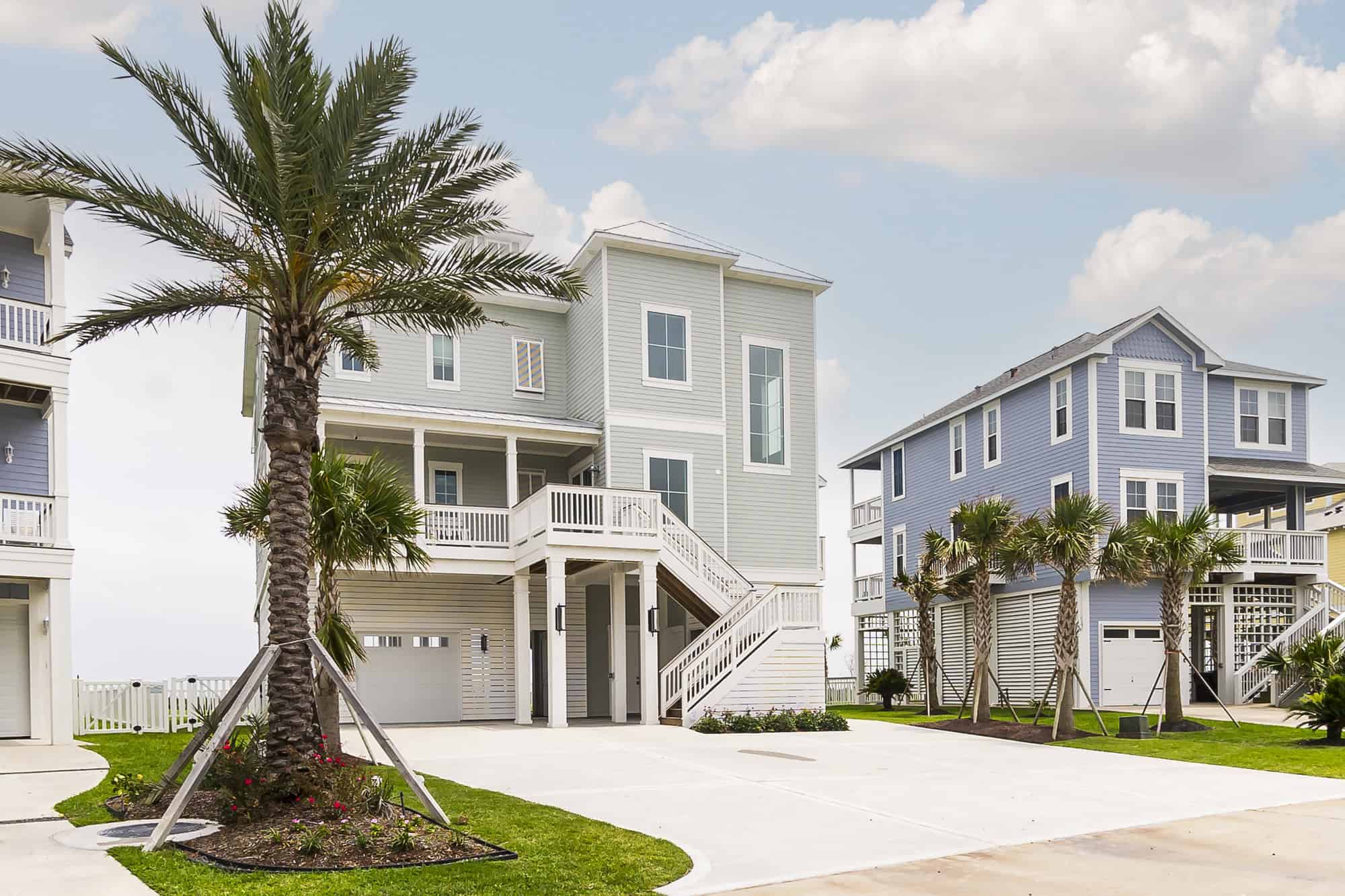
The Galveston West End is the stretch of Galveston Island west of the seawall, running roughly 20 miles to San Luis Pass. It’s where most new custom homes on the island are built: elevated on pilings, on beachfront, bay, canal and lagoon lots, in more than a dozen distinct communities with very different rules.
Kai Custom Homes is a Galveston custom home builder with 35+ completed coastal homes, and most of them are on the West End. We’ve built in Pointe West, Sweetwater Cove, Sunset Cove, Jamaica Beach and Pirates Cove, and every photo in this guide is a home we built. This guide compares the West End’s main communities for someone planning to build: lot types, gates and associations, rental rules, flood zones, and what a new home costs.
What Is the West End of Galveston?
The West End is everything on Galveston Island west of the end of the seawall, which stops around 103rd Street. Without the seawall’s protection, every home here is built on pilings, and the City of Galveston classifies the entire shoreline west of the seawall as an eroding area.
A few facts that shape where you build:
It’s mostly City of Galveston. Nearly every West End subdivision is inside Galveston city limits, which means City permits, City flood rules and City short-term rental licensing.
Jamaica Beach is the exception. It’s a separate city, incorporated in 1975, with its own permits and its own rental ordinance, per the Texas State Historical Association.
One main road. FM 3005 (Seawall Boulevard’s continuation, also called San Luis Pass Road) runs the length of the West End. Communities sit either on the Gulf side (beach) or the bay side (canals, lagoons, marsh).
The “Mile Roads.” Locals navigate by cross streets named for their distance along the island, such as 8 Mile Road and 13 Mile Road.
Galveston West End Communities at a Glance
The quickest way to narrow your search is by the kind of water you want outside your door. Here’s how the main communities compare.
Pointe West: beach, lagoon and bay lots at the island’s western tip. Private Beach Club with pools and a lazy river. POA with architectural review. Short-term rentals common.
Sweetwater Cove: small, gated, about 60 homesites on the bay and Sweetwater Lake, with a private boat launch. Quiet and low-density.
Sunset Cove: gated canal community on the bay side with boat slips, a ramp, a pool and courts. Reported to restrict short-term rentals; confirm with the association.
Jamaica Beach: its own city, with a large canal system, a marina and both beach and bay lots. City-run rental registration.
Pirates Beach, Pirates Beach West and Pirates Cove: part of a network of about 1,700 homes under one property owners association. Gulf-side beach sections and bay-side canal sections. Section-by-section deed restrictions; the bay-side Pirates Cove sections require 90-day minimum leases.
Laffite’s Cove: bay-side, private canals and a nature preserve, under both the Pirates association and its own.
Terramar Beach: about 600 platted lots on both sides of FM 3005, with bayfront, canal, beach and interior lots, plus a pool, pavilion and marina.
Sea Isle: established in 1950, about 1,600 lots on both sides of the road, with a pool, pier, marina and boat launch.
Kahala Beach Estates: beachfront lots only, with a homeowners association.
Indian Beach, Bermuda Beach, Spanish Grant and Beachside Village: beach-side neighborhoods ranging from established to highly architecturally restricted.
One more name comes up constantly: Tiki Island. It’s a canal community in Jones Bay off I-45, not on Galveston Island and not part of the West End, and it’s its own village with its own rules.
Beach, Bay or Canal: Choosing Your Lot Type
Your lot type decides more about your home than the community does. It sets your flood zone, your permits, your piling design and how you’ll spend your weekends.
Beachfront lots
Beachfront lots give you the Gulf view and the sound of the surf. They also carry the most regulation.
Construction within 1,000 feet of mean high tide needs a City Beachfront Construction Certificate and Dune Protection Permit, reviewed by the Texas General Land Office.
These lots are typically in FEMA’s VE zone, the coastal high-hazard zone where breaking waves are expected, which means deeper pilings and stricter engineering.
The Texas Open Beaches Act gives the public a right to use the beach up to the vegetation line, and you can’t build in a way that damages dunes or blocks access. The Texas General Land Office enforces it.
Bay and marsh lots
Bay lots trade surf for sunsets, birds and quiet water. Many look over protected marsh and open bay. They’re usually in an AE flood zone rather than VE, though you must confirm each parcel.
Canal and lagoon lots
Canal lots put a boat at your back door with access to West Bay. They add bulkheads, docks and boat lifts to your budget, and those structures need their own permits and inspections. Lagoon lots, like those in Pointe West, give you calm water for kayaks and paddleboards without the canal traffic.
Pointe West
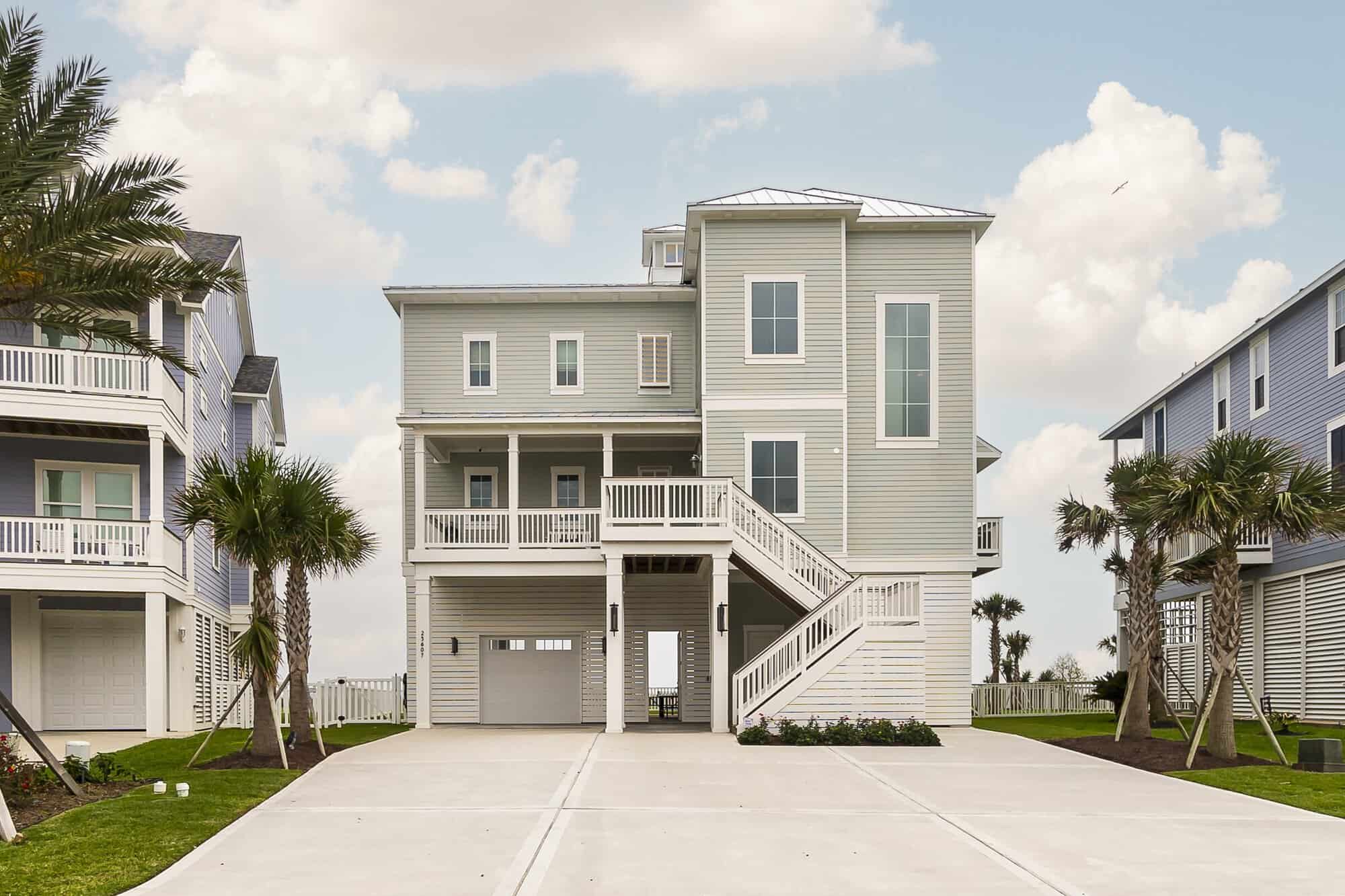
Pointe West is a master-planned community of roughly 1,000 acres covering the last three and a half miles of the island, next to the San Luis Pass bridge. It opened in 2006 and is the West End’s most amenitized community.
Amenities: a Gulf-front Beach Club with an infinity pool, lazy river, fitness center, seasonal restaurant and over a mile of vehicle-free beach.
Lots: beach, lagoon, bay-side and a larger-lot Estate Section.
Rules: an Architectural Review Board approves every new home, including style, size, materials and roof. Builders must be approved too.
Rentals: allowed and common.
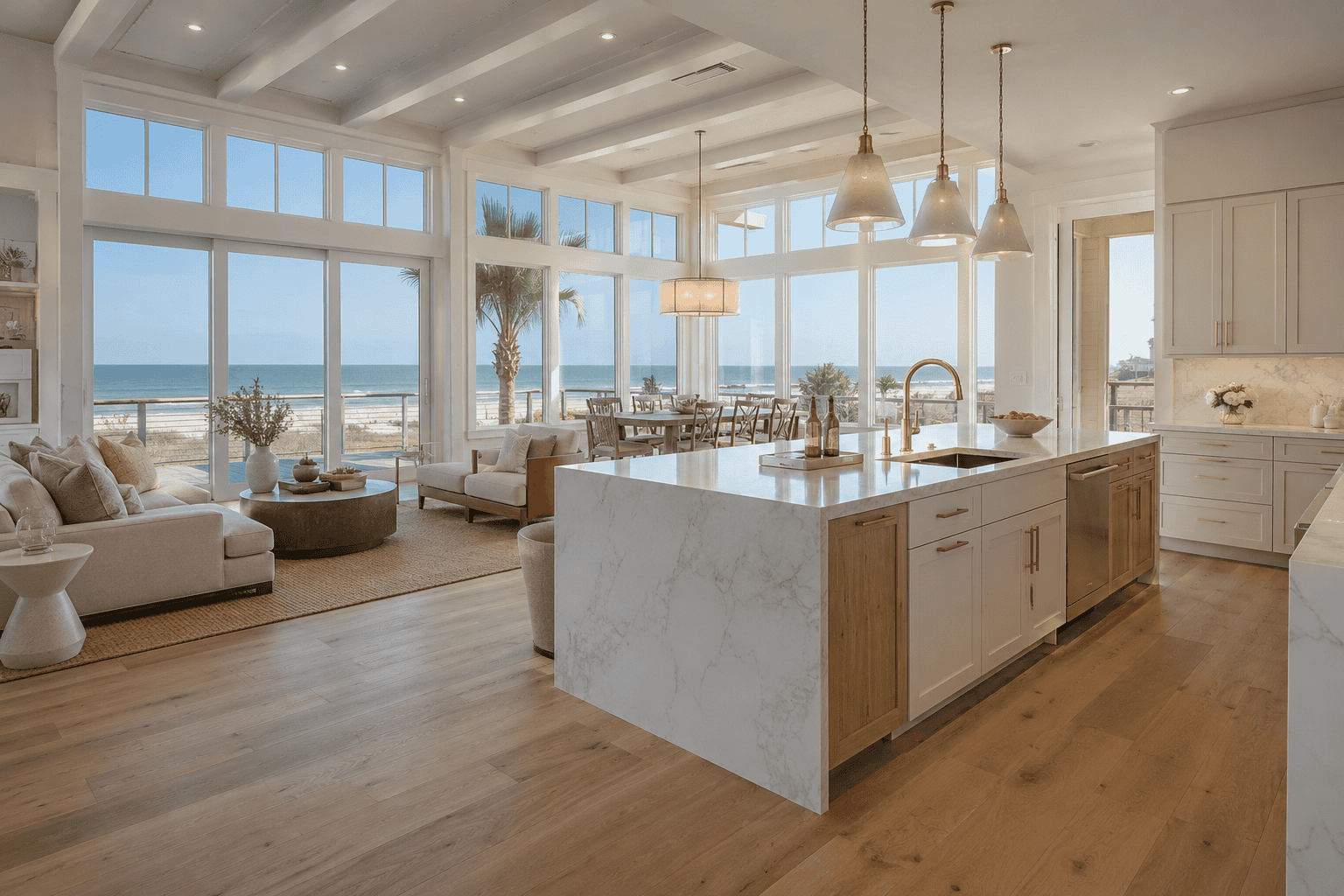
We built the home pictured here in Pointe West. It’s a good example of what the community’s coastal cottage style looks like done at a custom level: deep porches, a light exterior and an interior built around the water views.
Sweetwater Cove
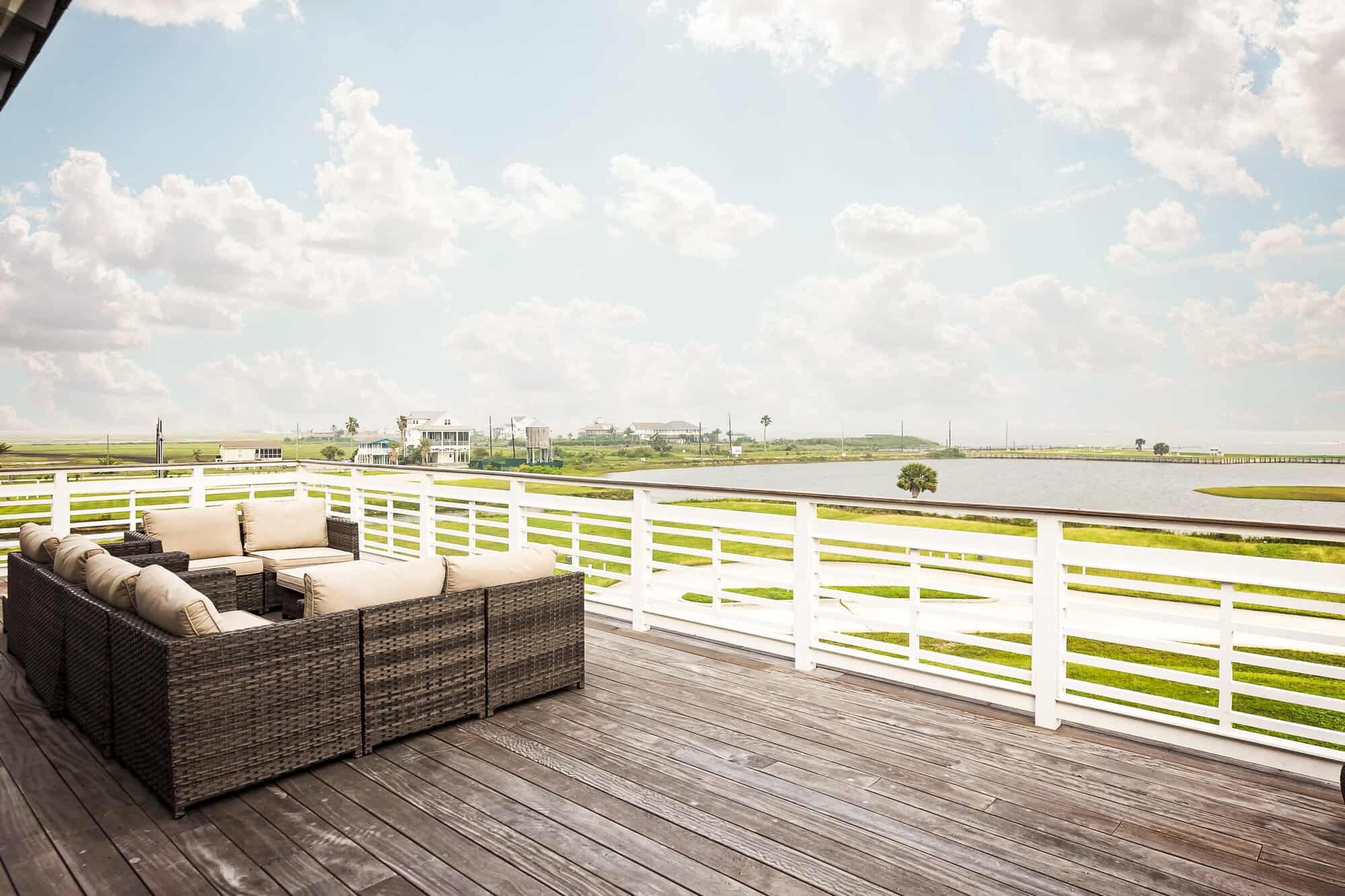
Sweetwater Cove is a small, gated community of about 60 homesites near 8 Mile Road, with West Bay to the north and Sweetwater Lake to the south. It’s one of the quietest places to build on the island.
Lots: bay and lake frontage, with new bulkheads and a private boat launch.
Feel: low-density, surrounded by protected marsh and preserve land.
Best for: buyers who want privacy and bay views over resort amenities.
The home we built in Sweetwater Cove sits on the marsh, with covered decks on multiple levels looking over the grass to open bay water.
Sunset Cove
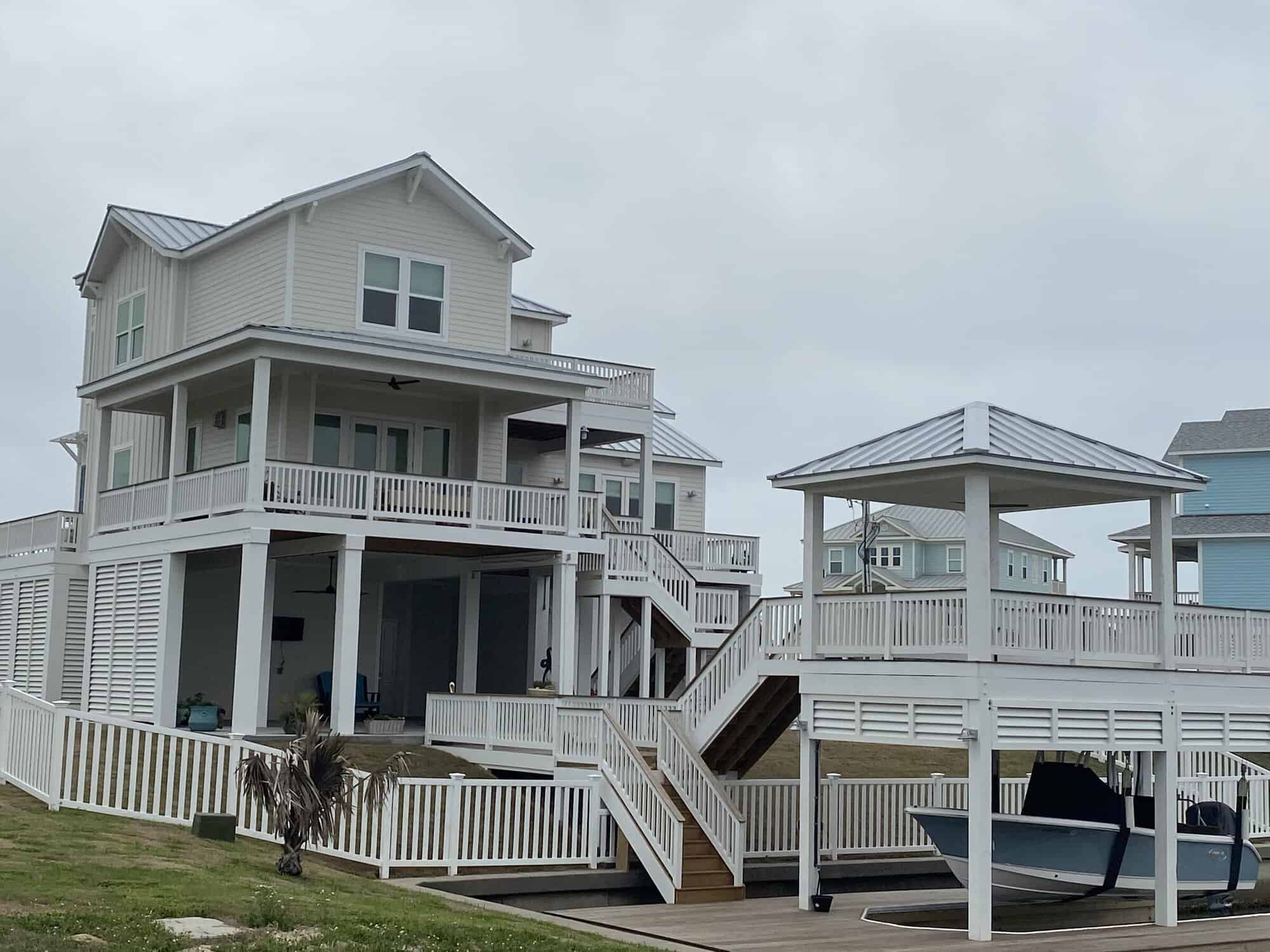
Sunset Cove is a gated canal community on the bay side of FM 3005, between Jamaica Beach and San Luis Pass. It’s built for boaters.
Lots: canal lots with a channel to West Bay, plus community boat slips and a ramp.
Amenities: pool, courts and a pavilion.
Rentals: reportedly restricted. Confirm current rules with the association before buying.
We’ve built two homes in Sunset Cove. The one pictured has a separate covered deck and a boat lift right off the back porch.
Jamaica Beach
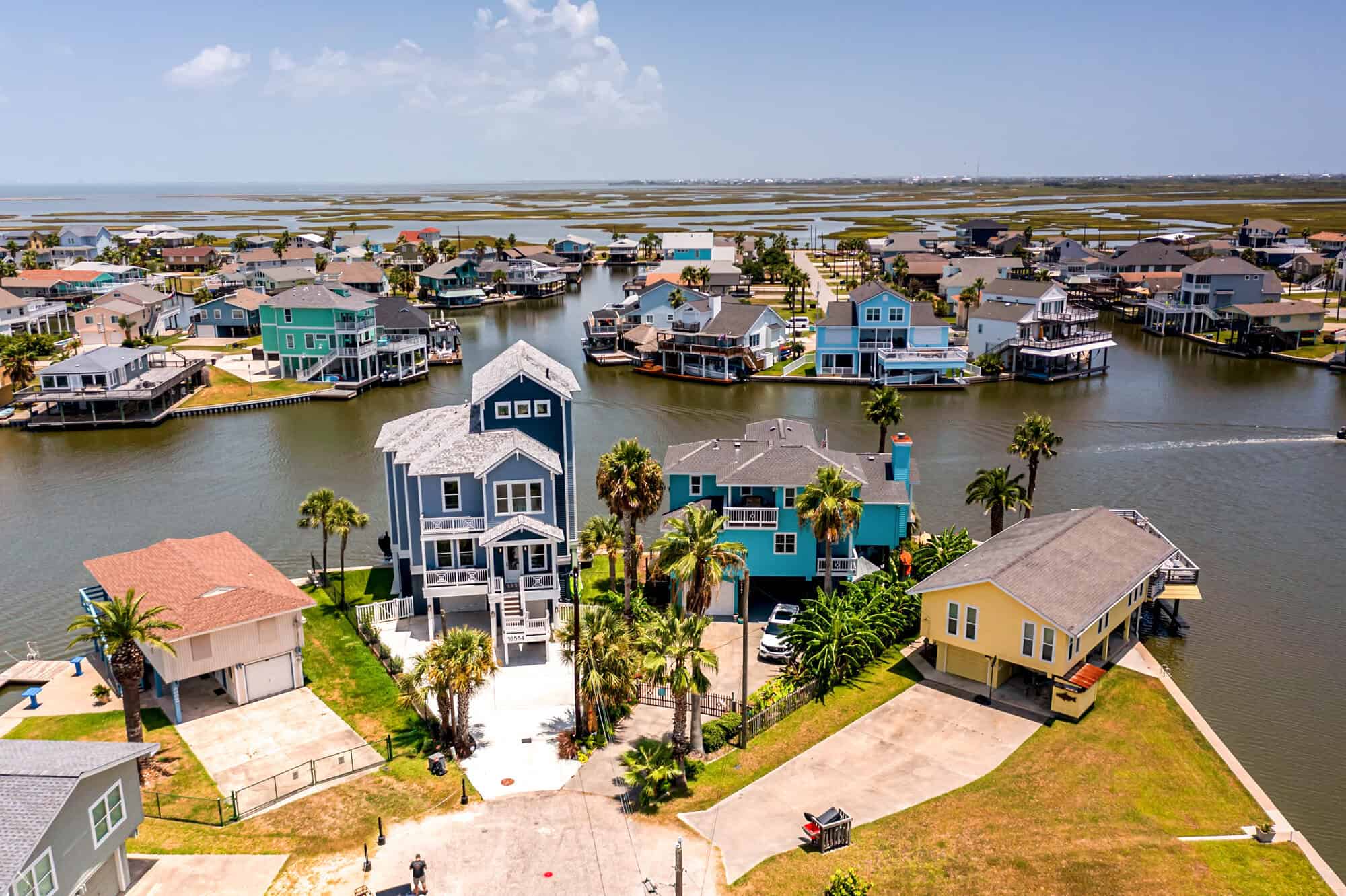
Jamaica Beach is a small city in the middle of the West End, developed from 1957 and incorporated in 1975. It has both beach and bay sides and one of the island’s largest canal systems.
Lots: canal, bay and beach lots, with public no-wake waterways and a marina.
Rules: Jamaica Beach issues its own permits and runs its own short-term rental program, including registration and occupancy limits.
Best for: families who want a boat, a canal and a small-town feel.
The canal home we built in Jamaica Beach is three stories on the water, with multi-level covered decks, a private dock and room to store a boat under the house.
Pirates Beach and Pirates Cove
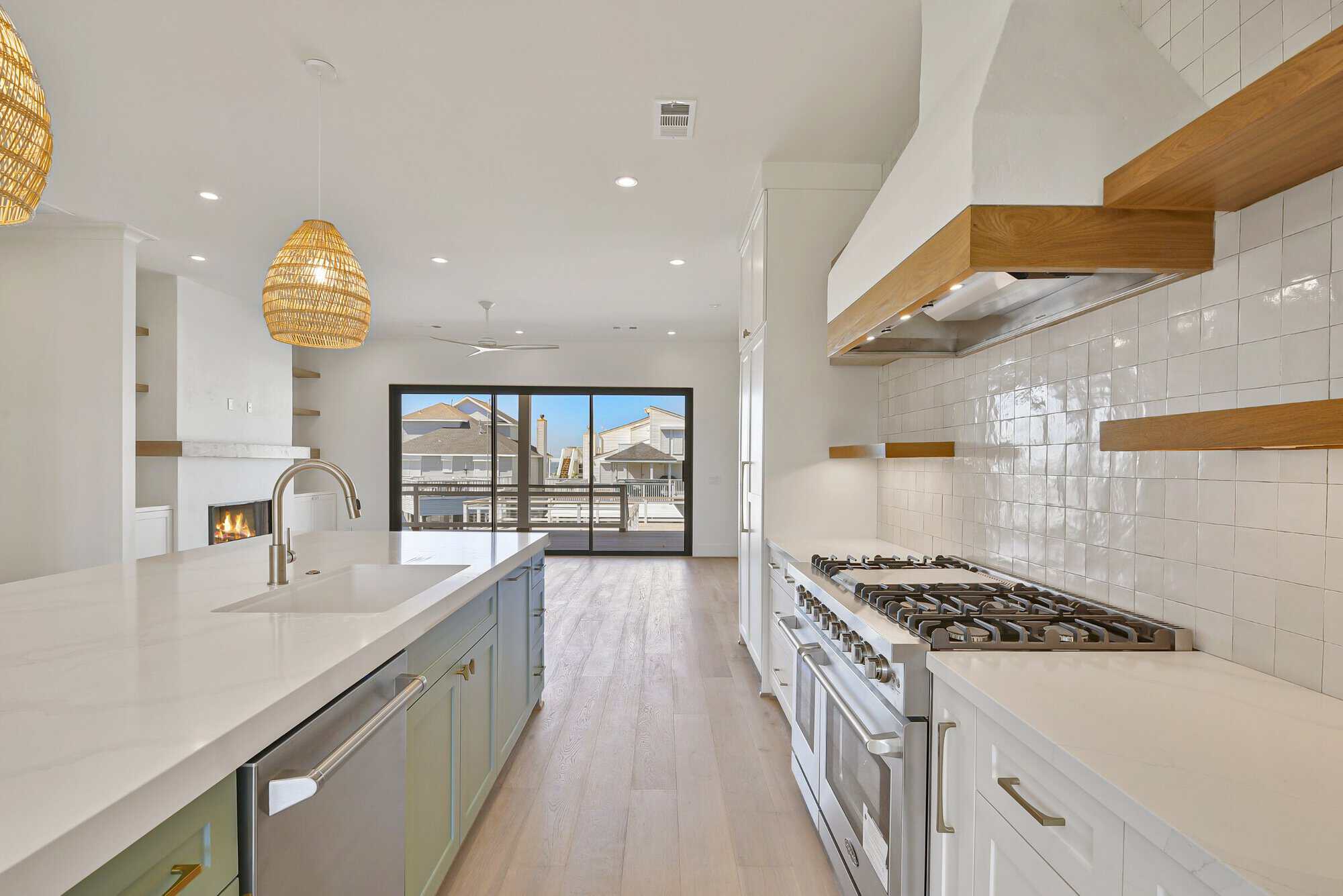
The Pirates neighborhoods are one of the West End’s largest and oldest groups of communities, with about 1,700 homes under the Pirates Property Owners Association. They include Gulf-side Pirates Beach and Pirates Beach West and bay-side Pirates Cove, Laffite’s Cove, The Enclave and The Villas.
Lots: Gulf-side beach lots, plus canal and lake lots with docks in Pirates Cove.
Rules: the association’s Architectural Review Committee approves every new home and dock, and each section has its own deed restrictions.
Rentals: vary by section. Pirates Cove, Laffite’s Cove, The Villas and Pirates Landing require leases of at least 90 days. Pirates Beach and Pirates Beach West currently have no rental restriction.
Best for: buyers who want an established neighborhood close to town, or a tear-down lot in a proven location.
Our Pirates Cove home is a good picture of what new construction looks like here: a chef’s kitchen with white oak, zellige tile and a professional range, over an open, pilings-up ground level on the canal.
Other West End Communities to Know
Beyond the communities where we’ve built, several others are worth a look:
Terramar Beach: a mix of beach, bay, canal and interior lots on both sides of the road, with a pool, pavilion and marina run by its community association.
Sea Isle: one of the older West End communities, with about 1,600 lots and a pool, pier and marina.
Kahala Beach Estates: all beachfront lots, under a homeowners association.
Indian Beach: a 1980s community with beach and bay lots, a recreation center and a bay fishing pier.
Bermuda Beach: about 190 beachfront homesites between Spanish Grant and Pirates Beach.
Spanish Grant and Beachside Village: beachfront subdivisions. Beachside Village is known for strict architectural standards.
If you’re comparing lots across several of these, we’re glad to look at them with you and tell you what each would take to build on. Start with a note on our contact page.
Flood Zones and Elevation on the West End
Every new home on the West End is built on pilings above the base flood elevation (BFE), which runs from about 11 feet to more than 15 feet on the island. Beachfront lots are commonly in FEMA’s VE zone; bay and interior lots are usually AE. Our guide to building in flood zone AE explains how that required height gets set.
The rules every build follows:
City of Galveston freeboard: new homes must sit at least 18 inches above the BFE, per the City’s flood protection requirements.
Current flood maps: Galveston’s FEMA flood maps took effect August 15, 2019. Check your exact parcel before you buy.
Windstorm certification: Galveston County is in the Texas Department of Insurance’s designated catastrophe area. To qualify for TWIA windstorm coverage, your home needs a WPI-8 certificate from inspections made during construction. See TDI’s windstorm program.
Elevation is where experience pays off most. Corby Broesche, Kai’s owner, personally sets the elevation and piling height on every home we build. The question isn’t only what the drawing says; it’s what’s 20 to 30 feet underground, how your home will sit next to the neighbors, and how high you should go to lower your flood insurance.
Short-Term Rental Rules on the West End
Short-term rentals are allowed in most of the West End, but three layers of rules can apply: the City, the community association and, in Jamaica Beach, a separate city.
City of Galveston: every short-term rental needs an annual City license, a registration number on every listing, and a local contact who responds within an hour. The City took over rental registration and hotel occupancy tax from the Park Board in October 2025. See the City’s hotel occupancy tax page.
Jamaica Beach: its own registration, fees and occupancy rules.
Associations: some restrict rentals. Pirates Cove and Laffite’s Cove require 90-day minimum leases, and Sunset Cove reportedly restricts short-term rentals.
If rental income is part of your plan, confirm the rules for your exact lot and section before you buy. If it isn’t, a community with rental limits may be exactly what you want.
Insuring a New Home on the West End
Every West End home needs two policies beyond standard homeowners coverage: flood insurance and windstorm coverage. A new home built to current code puts you in a far stronger position on both than an older resale home.
How the pieces fit together:
Flood insurance usually comes through the National Flood Insurance Program or a private carrier. Your premium depends heavily on your flood zone and how far your lowest floor sits above the base flood elevation.
Windstorm coverage on the Texas coast often comes from the Texas Windstorm Insurance Association (TWIA). Your home only qualifies if it earns a WPI-8 windstorm certificate from inspections made during construction. Skip an inspection and you can’t go back and inspect work that’s already covered up.
Your elevation certificate is the single most important insurance document you’ll get from your build. It records exactly how high your home sits, and your flood premium is priced from it.
Three decisions during design move your premiums for as long as you own the house:
How high you build. Going above the required elevation often lowers flood premiums enough to pay for itself over time. We’ll show you that math in dollars before you decide.
What you enclose at ground level. Large enclosed spaces below the flood elevation can raise premiums. Open parking, lattice screening and breakaway walls keep the ground level flood-friendly.
How the structure is built. Impact-rated windows, a properly attached roof and a continuous load path from roof to foundation all matter at inspection and in a storm.
Talk to your insurance agent early, ideally before you finalize your plans. The cheapest time to lower a premium is before the pilings go in.
What Does It Cost to Build on the West End?
A new custom elevated home on the Galveston West End typically costs about $350 to $500+ per square foot to build. For the 2,500 to 4,000 square foot homes we usually build, that’s $1.5 million to $3 million or more, before the lot. Our full Galveston cost guide breaks down where that money goes.
Where your home lands in that range depends on:
Lot type: beachfront permitting and VE-zone pilings cost more than a bay or interior lot.
Waterfront structures: bulkheads, docks and boat lifts on canal lots.
Structure: we build with concrete columns and insulated concrete form (ICF) walls rated for 200 mph winds where the design allows. It costs more than wood framing and holds up better on this coast.
Association requirements: design standards, review fees and deposits.
Finishes: kitchens, tile and millwork, where budgets move most once the structure is set.
Plan on 12 to 18 months from permit to keys. You’ll get a written update from us every two weeks during construction and every week during finishes, so you’re never guessing where your home stands.
How to Choose Where to Build on the West End
Start with how you’ll use the house, then pick the water, then pick the community. In our experience, that order saves buyers months.
Decide how you’ll use it. Weekends, retirement, family gatherings or rental income each point to different communities.
Choose your water. Beach, bay, canal or lagoon.
Check the rules. Rental limits, architectural review and deed restrictions for the exact section.
Check the flood zone for the exact parcel, and what it means for your piling design and insurance.
Have your builder walk the lot before you buy. The costs that surprise people, like piling depth, bulkhead condition and beachfront permitting, are visible to someone who’s built there.
Frequently Asked Questions About the Galveston West End
What is the West End of Galveston?
The West End is the part of Galveston Island west of the end of the seawall, stretching to San Luis Pass. It’s mostly residential, with beach, bay and canal communities, and every home is built on pilings.
Which end of Galveston is best?
It depends on what you want. The East End and the area behind the seawall offer historic homes and city convenience. The West End offers newer homes, beach and bay lots, and quieter communities, which is why most new custom homes are built there.
Is East or West Galveston better for building a new home?
For new custom construction, the West End usually is. It has more buildable lots, more waterfront, and communities designed around elevated coastal homes. The East End has less vacant land and more historic-district rules.
Are West End homes required to be on stilts?
Effectively, yes. The West End sits outside the seawall in FEMA flood zones, so new homes must be elevated above the base flood elevation plus the City’s 18-inch freeboard, which on the West End means pilings.
Do I need a builder who has built on the West End?
You need one who knows its permits, associations and flood rules. Beachfront permitting, VE-zone engineering and association review each have their own requirements, and a builder learning them on your project costs you time and money.
Build on the Galveston West End With Kai
The West End has a community for almost every version of the coastal dream: a resort beach club, a quiet gated cove, a canal with a boat lift, an established beach neighborhood. The right lot and the right builder matter more than the address.
We’ve built across the West End, and we’ll tell you what it would take to build on any lot you’re considering. Call us at 713-909-0059, or send us the lot details through our contact page. We’ll give you a real number and explain exactly what drives it.