ICF blocks cost roughly $5 to $8 per square foot of wall area for the blocks alone, and $20 to $35 per square foot installed — meaning forms, rebar, concrete, bracing, and the crew that puts it all together. On a typical Gulf Coast home, choosing ICF over wood framing adds somewhere between 3% and 10% to the total build cost.
That’s the answer. Most pages that rank for this question won’t give it to you, because most of them are selling blocks.
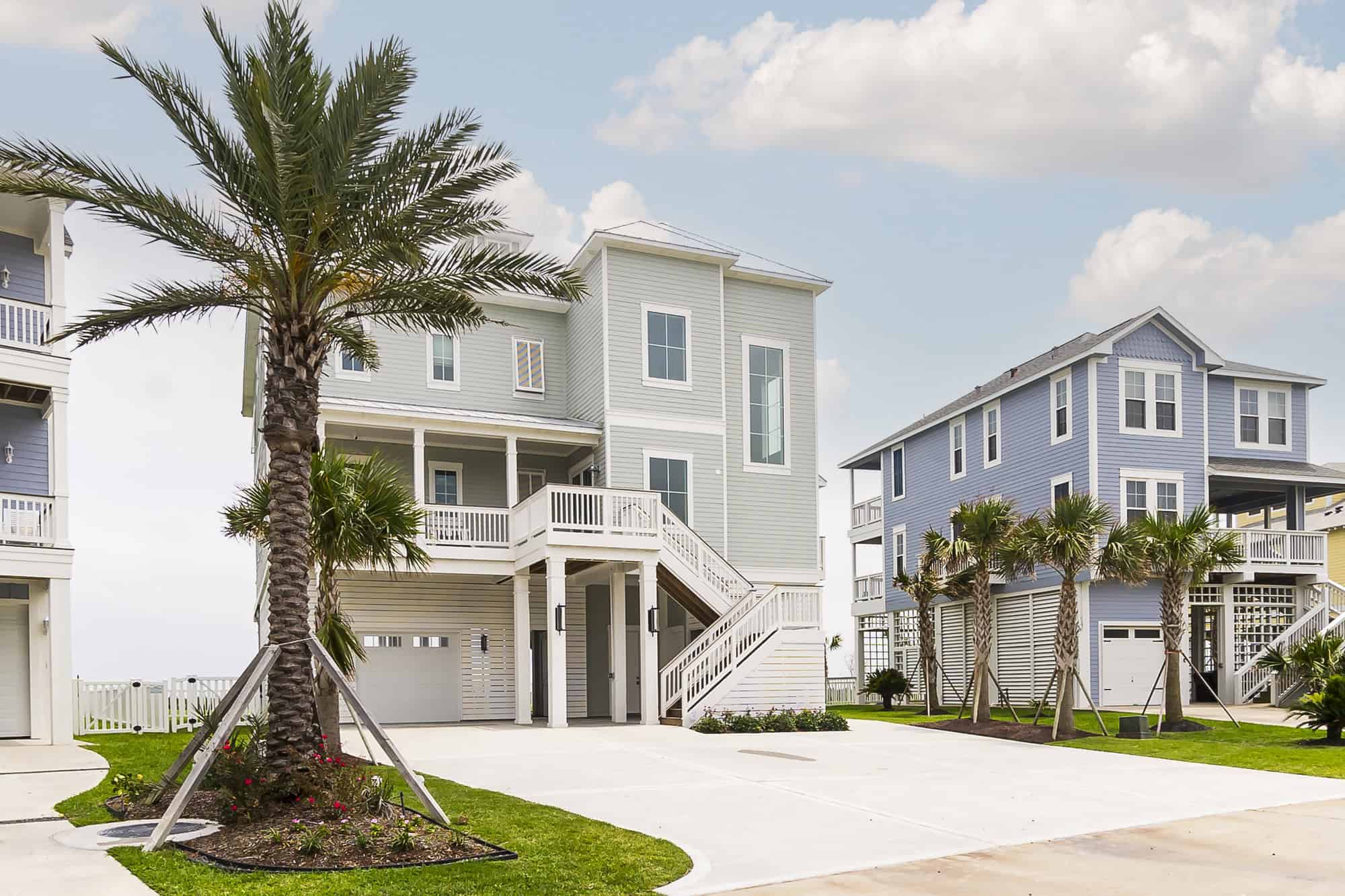
Kai Custom Homes is a custom home builder on Galveston Island, and we build with insulated concrete forms on the Texas Gulf Coast — the West End, Bolivar Peninsula, Crystal Beach, and San Luis Pass. We’ve completed 35+ homes on this island. This article breaks down what ICF actually costs on a real coastal project, what moves the number up or down, and when the premium is worth paying.
What Are You Actually Buying When You Buy ICF Blocks?
An ICF block is not a finished wall. It’s a form that stays in place. Understanding that is the key to understanding the price.
Each block is typically two rectangles of rigid foam — usually expanded polystyrene — held apart by plastic or metal ties. You stack them like oversized Lego, thread rebar through the cavity, and pour concrete into the middle. The foam never comes off. It becomes permanent insulation on both faces of a solid concrete wall, which is why the Department of Energy’s Building America program describes ICF walls as providing continuous insulation without thermal bridging, along with air sealing and structural strength in a single assembly.
So when someone quotes you an “ICF block cost,” ask what’s in the number. Three very different figures get used interchangeably:
- Block only — the foam forms delivered to your site. Roughly $5–$8 per square foot of wall.
- Materials complete — blocks, rebar, concrete, bracing, and accessories. Roughly $12–$18 per square foot of wall.
- Installed — everything above plus labor, pump, and placement. Roughly $20–$35 per square foot of wall.
A supplier’s website is quoting the first number. Your builder is quoting the third. That gap is where most of the confusion about ICF pricing lives.
ICF Block Cost Per Square Foot: The Real Numbers

Here’s how ICF costs break down on the coastal projects we build, in 2026 dollars.
| What you’re pricing | Typical range | What’s included |
|---|---|---|
| ICF blocks (material only) | $5–$8 / sq ft of wall | Foam forms and ties, delivered |
| Rebar and accessories | $1.50–$3 / sq ft of wall | Reinforcing steel, bracing, corners, bucks |
| Concrete (placed) | $5–$9 / sq ft of wall | Ready-mix plus pump time |
| Labor | $8–$15 / sq ft of wall | Stacking, bracing, pour, cleanup |
| Installed ICF wall | $20–$35 / sq ft of wall | All of the above |
To turn wall square footage into a home price, you need wall area, not floor area. A 3,000 sq ft two-story home has roughly 3,000–3,600 sq ft of exterior wall once you account for wall height and perimeter. At $28 per square foot installed, that’s about $84,000 to $100,000 for the exterior wall shell.
Compare that to a conventional wood-framed, sheathed, and insulated exterior wall on the same house — call it $16 to $22 per square foot installed — and the ICF premium comes out to roughly $25,000 to $45,000 on that size of home.
On a $1.5M to $3M coastal build, that’s a 2% to 4% difference. It’s real money, and it’s a much smaller number than most people expect when they first hear “concrete house.”
What Drives ICF Block Cost Up or Down
Five things move the number more than anything else.
Wall thickness. ICF blocks come in different core sizes — commonly 4″, 6″, 8″, and 10″ of concrete. A 6″ core is standard for most residential walls. Coastal wind loads and taller walls push you to 8″, and each step up adds concrete volume and block cost.
Wall height and story count. Taller walls need more bracing, more scaffolding, and more pump time. A three-story elevated coastal home is more expensive per square foot of wall than a single-story slab-on-grade house, even with identical blocks.
Openings. Windows and doors are the expensive part of an ICF wall. Every opening needs a buck, a lintel, extra rebar, and careful bracing so the pour doesn’t blow out. A wall of glass facing the Gulf costs considerably more than a solid wall of the same dimension.
Complexity of the footprint. Corners, angles, curves, and step-downs all slow the stack and increase waste. A simple rectangle is the cheapest ICF you’ll ever buy.
Crew experience. This is the one nobody warns you about. An experienced ICF crew stacks fast and pours clean. An inexperienced one has blowouts — a form failure mid-pour that costs you concrete, time, and sometimes a wall. On the Gulf Coast, where ICF is still relatively new, crew availability is a genuine cost factor.
That last point is worth sitting with. If you’re building on Galveston Island and comparing bids, ask each builder how many ICF homes they’ve actually completed — not how many they’ve priced. We’d rather have that conversation with you early than have you find out during the pour. Call us at 713-909-0059 and we’ll walk you through it honestly.
Is ICF Cheaper Than Poured Concrete?
Generally, yes — ICF is usually cheaper than conventional poured concrete walls once you account for everything.
Traditional poured walls require forms that get set, stripped, cleaned, and hauled away. Then you still have to insulate and furr the wall separately. ICF eliminates the form-stripping labor entirely and delivers the insulation in the same operation. The forms cost more; the labor costs less; the insulation comes free.
Where poured concrete still wins is on very large, very simple walls where forming systems can be reused many times — commercial work, mostly. For a custom home, ICF is almost always the more economical concrete wall.
Does ICF Save You Money Later?
This is where the math gets more favorable, and it’s the part worth weighing against the upfront premium.
Energy. ICF walls combine continuous insulation with high thermal mass, which the Building America Solution Center notes moderates indoor temperature swings by absorbing and slowly releasing heat. On the Gulf Coast, where the cooling season runs most of the year, that shows up on the electric bill every month for the life of the house.
Insurance. Windstorm and homeowners premiums on Galveston Island are a significant line item, and construction type matters. Concrete exterior walls and a properly engineered load path can change what you pay. Talk to your carrier before you finalize the wall system — the answer varies more than people expect.
Durability. Concrete doesn’t rot, and it doesn’t feed termites or mold. In a marine environment with 90% humidity and salt in the air, that matters over a 30-year ownership horizon.
Storm performance. This is why we use ICF here at all. Kai builds with insulated concrete forms, insul-deck, and other materials rated to 200 mph wind loads. Most builders on this island don’t use concrete columns and concrete exterior walls — we do. Every home on the West End sits in a FEMA flood zone and a Texas windstorm zone, and the Texas Department of Insurance requires windstorm certification for coastal construction. A wall system that starts out stronger makes that whole conversation easier.
FAQ
How much do insulated concrete forms cost?
Insulated concrete forms cost about $5 to $8 per square foot of wall for the blocks alone, and $20 to $35 per square foot installed. On a 3,000 sq ft home, the installed exterior wall shell typically runs $84,000 to $100,000.
Is ICF cheaper than poured concrete?
Usually, yes. ICF costs more in materials but less in labor, because the forms are never stripped and the insulation is installed in the same step. For custom homes, ICF is typically the more economical way to build a concrete wall.
What are the disadvantages of ICF?
The three real ones are upfront cost, crew availability, and design changes. ICF adds 3–10% to a build, experienced crews are limited in some markets, and once the concrete cures, moving a window is genuinely expensive. As Corby puts it: it’s cheap before sheetrock; it gets expensive after. That’s doubly true with concrete.
What goes on the outside of ICF blocks?
Any standard exterior finish — stucco, fiber cement, stone, brick, or metal panel — attached to the plastic or metal ties molded into the foam. On coastal homes we favor finishes that handle salt air and can be inspected easily.
How many ICF blocks will I need?
Divide your total exterior wall area by the face area of one block. A common 16″ x 48″ block covers about 5.33 square feet, so a 3,200 sq ft wall needs roughly 600 blocks before waste. Add 5–10% for cuts, corners, and openings.
Let’s Price Your Build Honestly
If you’re weighing ICF for a home on Galveston Island, the West End, Bolivar, or Crystal Beach, the number that matters isn’t the block price — it’s what the finished wall costs on your lot, at your elevation, with your window schedule. We’ll give you that number.
Kai Custom Homes builds coastal stilt and concrete homes across the Texas Gulf Coast, typically $350 to $500+ per square foot, with real pricing from the first conversation and written updates every two weeks once we break ground. No runaround, no “pricing varies.”
Call Corby directly at 713-909-0059 — someone here answers the phone — or send us your plans through the contact page and we’ll price the ICF option against conventional framing side by side, so you can decide with real numbers in front of you.